
ISO 5348 Accelerometer Mounting Guide: Selecting Magnetic Mounting Bases, Thread Pitches & Metrology
Comprehensive engineering guide to ISO 5348 mechanical mounting of accelerometers, contact stiffness, frequency response, and selecting Ø20mm to Ø35mm magnetic bases for predictive maintenance in India.
1. Introduction to Accelerometer Mounting Dynamics (ISO 5348)
In industrial condition monitoring, predictive maintenance (PdM), and NVH testing, the accuracy of high-frequency vibration measurement is governed fundamentally by the mechanical coupling stiffness ($k$) between the piezoelectric sensor and the machine test structure. According to ISO 5348 (Mechanical Mounting of Accelerometers), any compliance, air gap, or flexure at the mounting interface creates a low-pass filter and lowers the mounted resonance frequency ($f_n$), causing severe signal distortion and amplitude attenuation at higher harmonics.
2. Why Precision Magnetic Mounting Bases Are Critical in Predictive Maintenance
While permanent stud mounting provides the highest stiffness, route-based walkaround data collection on plant machinery (motors, centrifugal pumps, gearboxes, blowers, compressors) requires fast, repeatable, and non-destructive sensor attachment. High-performance magnetic mounting bases solve this challenge by providing:
- High Clamping Preload: Permanent high-coercivity magnetic cores maintain continuous intimate contact under intense dynamic machine acceleration.
- Concentric Lathe Machined Surface: Precision CNC-turned flat mating faces eliminate rocking motion and keep transverse cross-axis sensitivity below 3%.
- Standardized Threaded Interfaces: Direct female threading allows zero-backlash integration with standard 10-32, 1/4-28, M3, M5, M6, and M8 accelerometer studs.
3. Selecting the Right Diameter, Thickness, and Thread for Your Application
BCNT Technologies manufactures 20 standard magnetic mounting base models across four dimensional groups, each available for direct procurement in the Magnetic Mounting Bases Catalog:
A. Ø20 mm Series (6 mm Thickness)
Ideal for lightweight single-axis accelerometers, tight-clearance bearing caps, and high-frequency acoustic monitoring. Available models: BCNT-MAG-20-M3, BCNT-MAG-20-M5, BCNT-MAG-20-M6, BCNT-MAG-20-10-32, and BCNT-MAG-20-1/4-28.
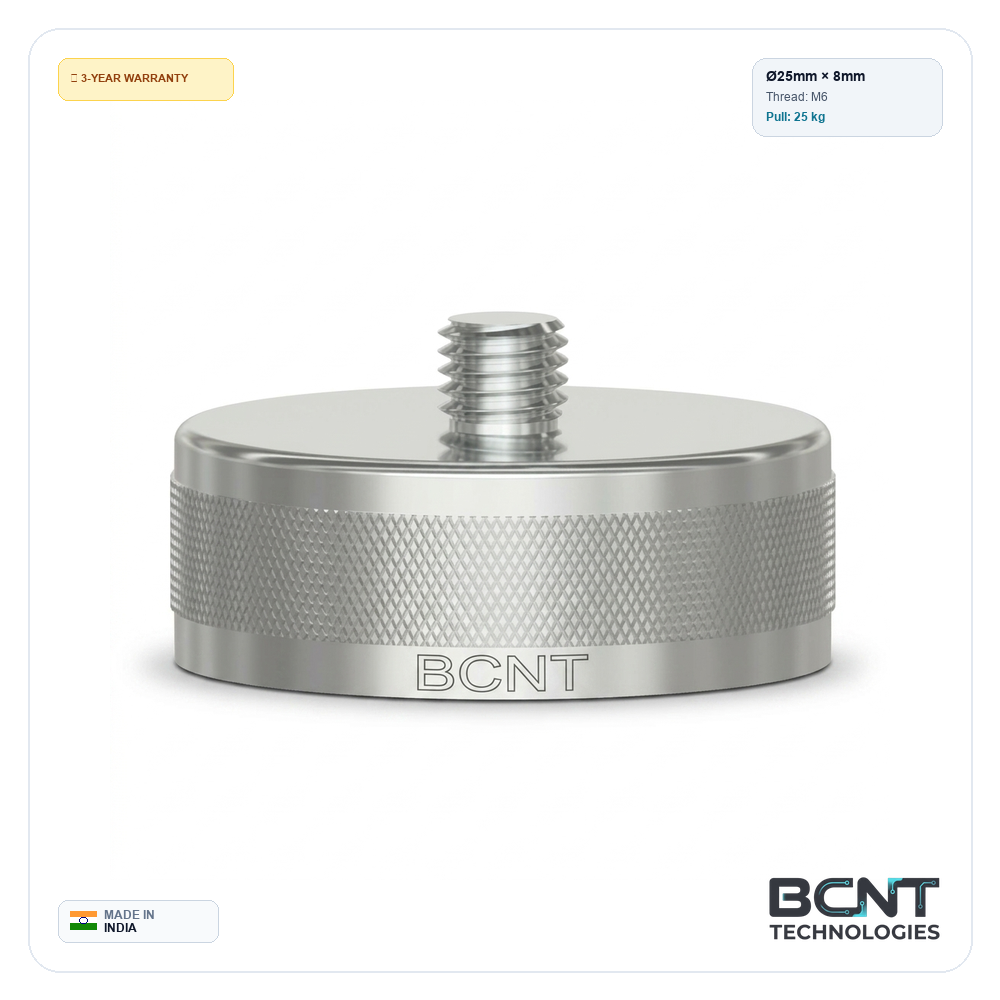
B. Ø25 mm Series (8 mm Thickness)
The industry workhorse standard for general plant predictive maintenance and triaxial sensor cube setups. Available models: BCNT-MAG-25-M3, BCNT-MAG-25-M5, BCNT-MAG-25-M6, BCNT-MAG-25-10-32, and BCNT-MAG-25-1/4-28.
C. Ø30 mm Series (8 mm Thickness)
Engineered for heavier velocity transmitters, 4-20mA loop-powered vibration sensors, and medium-speed gearboxes. Available models: BCNT-MAG-30-M5, BCNT-MAG-30-M6, BCNT-MAG-30-M8, BCNT-MAG-30-10-32, and BCNT-MAG-30-1/4-28.
D. Ø35 mm Series (10 mm Thickness)
Heavy-duty high-pull magnetic base designed for high-vibration heavy machinery, mining screens, turbines, and large industrial pumps. Available models: BCNT-MAG-35-M5, BCNT-MAG-35-M6, BCNT-MAG-35-M8, BCNT-MAG-35-10-32, and BCNT-MAG-35-1/4-28.
4. Best Practices for Accurate Walkaround Vibration Data Collection
- Clean Contact Surface: Ensure the ferromagnetic machine surface is free of thick paint flakes, heavy rust, or grit.
- Careful Magnetic Placement: Roll the magnetic base onto the surface from an angle rather than dropping it directly, preventing acoustic shock overload to delicate piezoelectric crystals.
- Coupling Gel: Applying a thin layer of silicone grease or petroleum jelly between the magnetic face and the machine surface fills microscopic air gaps and maximizes high-frequency transmissibility.
5. Nationwide B2B Availability & Custom Engineering in India
BCNT Technologies manufactures all mounting bases in Kerala, India, and provides direct express delivery to industrial hubs across Maharashtra (Pune, Mumbai), Karnataka (Bengaluru), Tamil Nadu (Chennai, Coimbatore), Gujarat (Ahmedabad, Vadodara), Telangana (Hyderabad), and Delhi NCR with full GST invoicing, material certificates, and our 3-Year Comprehensive Warranty.